From Vision to Production: the whole series, in one place
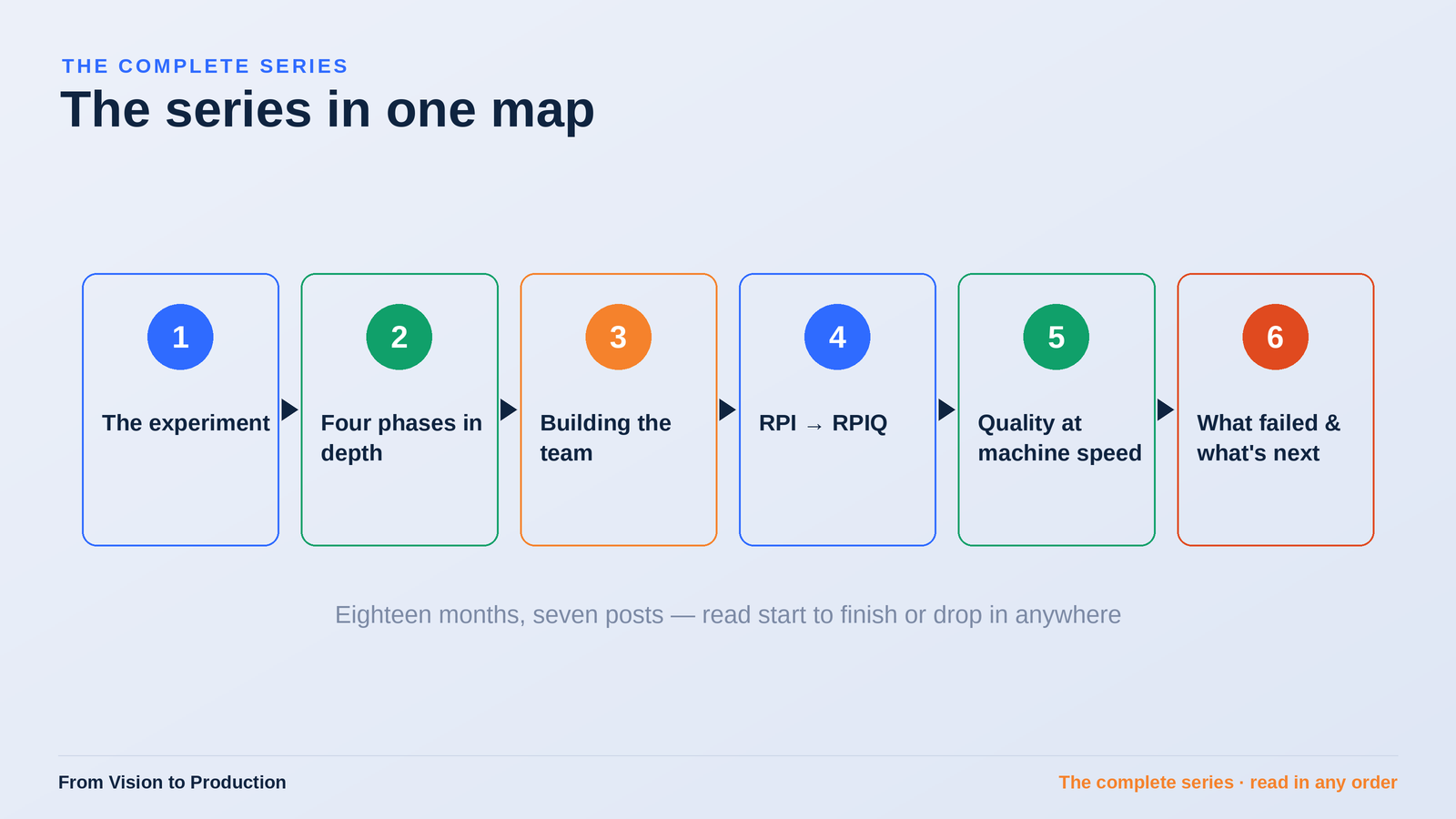
Over seven posts I wrote down how it actually happened: what worked, what it cost, and what failed. This is the map to all of it, so you can start wherever you want.
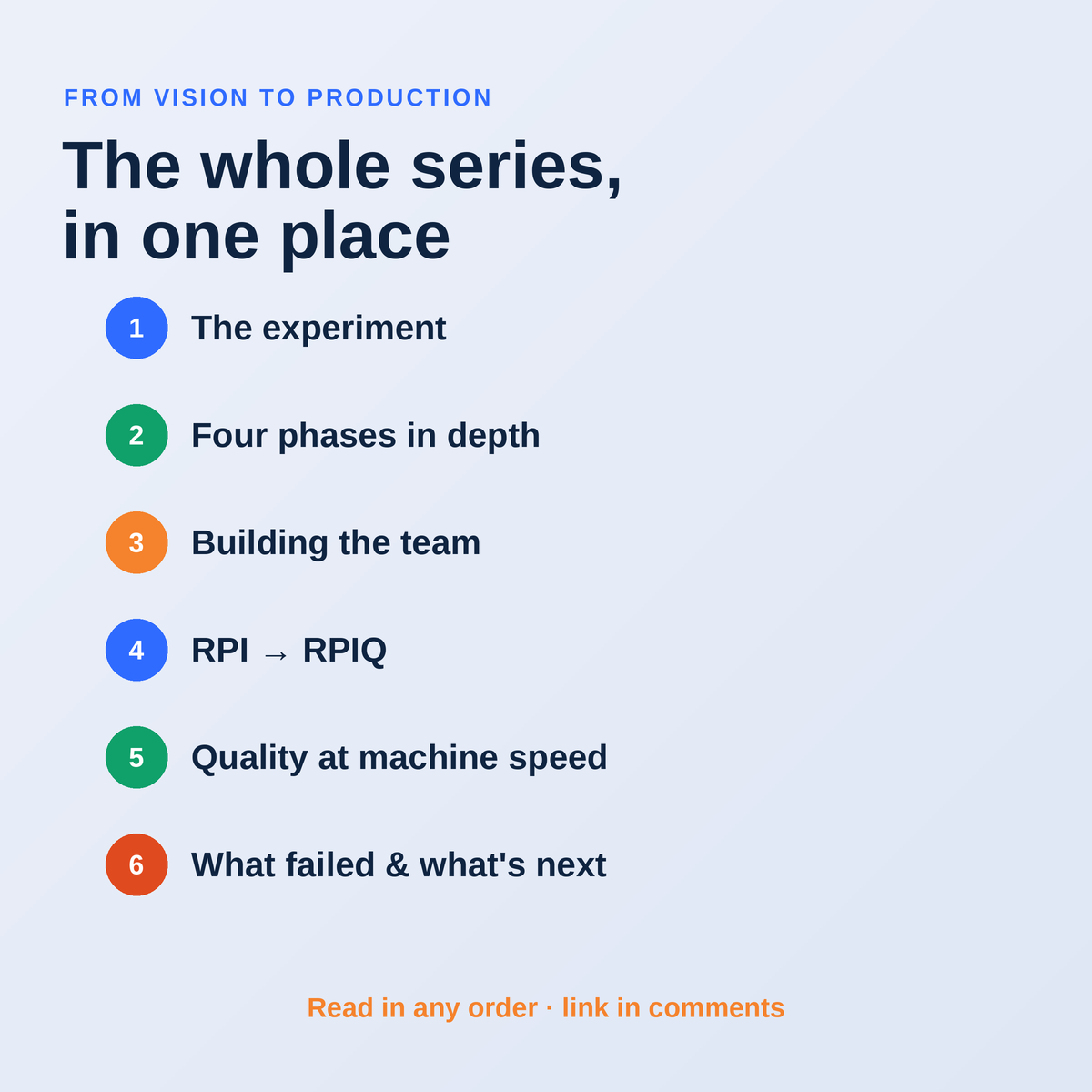
The complete "From Vision to Production" arc — read in any order.
Eighteen months ago I had twenty years in software QA and had never written a line of Swift. Today there's a production iOS app on the App Store — BowSmith — built solo, with AI, using a method I worked out by breaking things until they stopped breaking. Over seven posts I wrote down how it actually happened: what worked, what it cost, and what failed. This is the map to all of it, so you can start wherever you want.
The thesis, in one paragraph
The experiment was simple to state and uncomfortable to test: can a domain expert with no experience in a language ship real, production-grade software by directing AI rather than writing most of the code? The answer turned out to be yes — but not because the models are magic. It worked because of a method (RPIQ), a team of agents that reviewed each other across models, a quality system with around seventy thousand tests behind it, and an economic shift that put all of it within reach of one person. The rest of the series is those four things in detail.
The four pillars
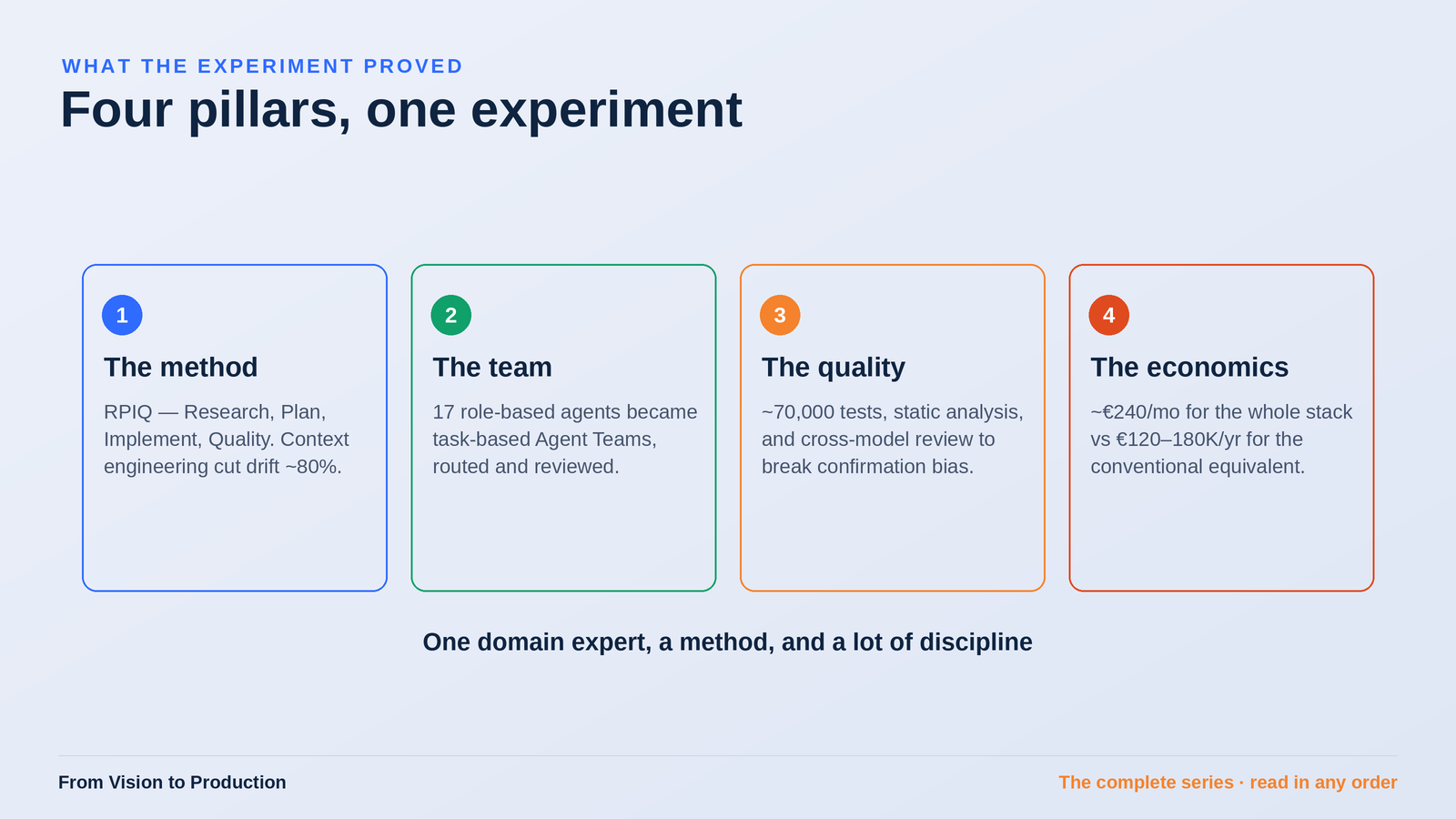
The method. RPIQ — Research, Plan, Implement, Quality — is the loop everything runs inside. Promoting Quality from a step to a first-class stage, plus context engineering and reusable templates, cut context drift by roughly 80%.
The team. What started as seventeen role-based agents became task-based, ephemeral Agent Teams — an organization I can't see but depend on, with work routed, reviewed, and gated.
The quality. Around seventy thousand tests, static analysis for dead code and duplication, and cross-model review to break the confirmation bias a single model can't escape on its own.
The economics. Roughly €240 a month for the whole stack, against €120,000–180,000 a year for the conventional equivalent — not a claim that a subscription replaces a team, but that the cost of trying has collapsed.
Three findings worth stealing
If you take nothing else from the series, take these three. They're the parts that changed how I work, and none of them is specific to archery apps or iOS.
Cross-model review beats same-model review. The model that writes the code carries its blind spots into the review of that same code. A different model, reviewing, is the cheapest way I found to break the echo chamber.
Context engineering beats prompt cleverness. The wins didn't come from clever wording. They came from pinning the right context, every time, so the model never had to guess what it already should have known.
Quality had to become a stage, not a step. The single most consequential change in the whole method was moving the "Q" out of the tail end of implementation and making it its own phase with its own gates. That's the difference between RPI and RPIQ.
Pick your entry point
The arc rewards reading start to finish, but it was built so you can drop in anywhere depending on what you're here for.
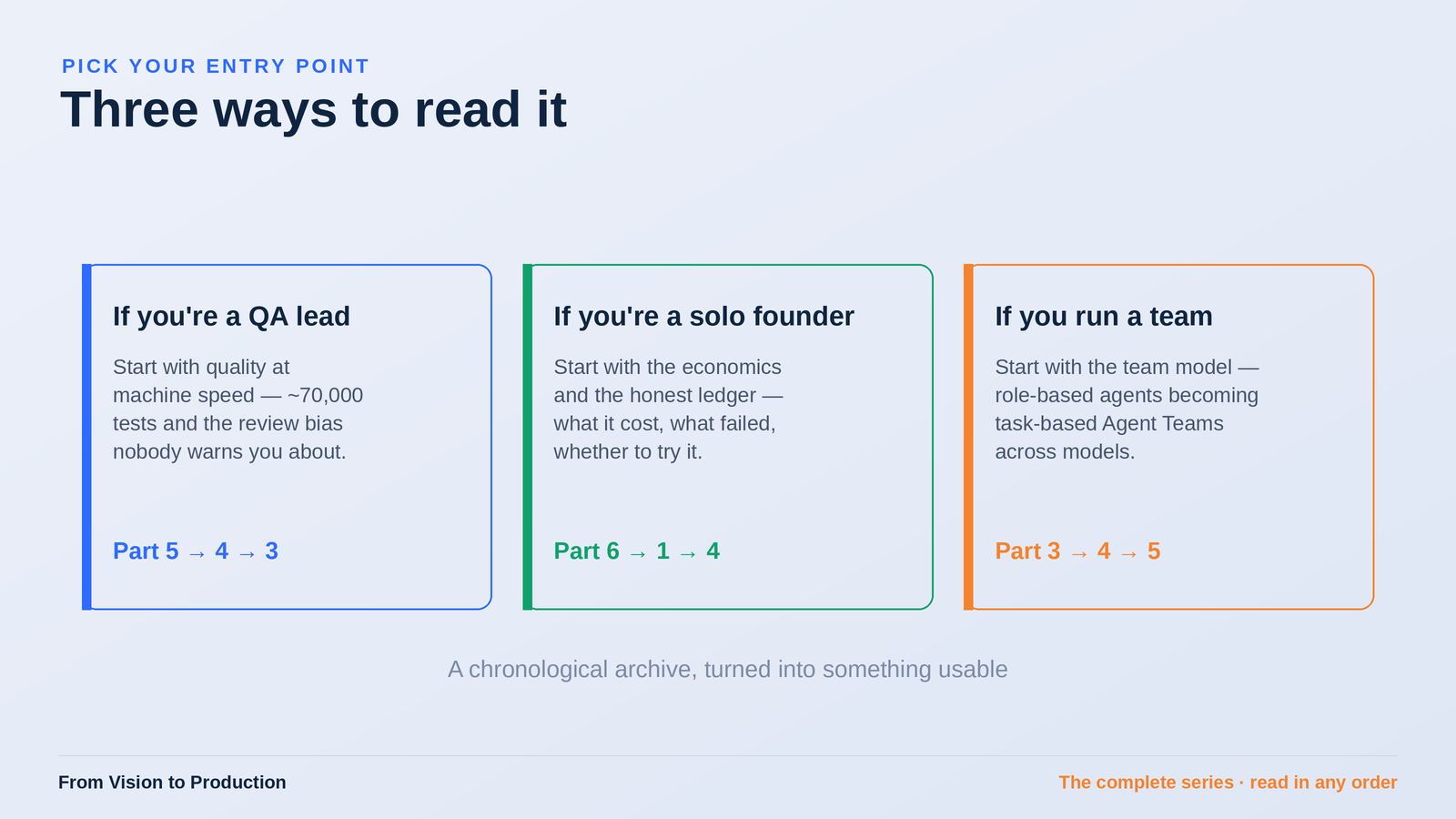
If you're a QA lead, start with quality at machine speed — the test count, the static analysis, and the review bias nobody warns you about — then work back to the method and the team.
If you're a solo founder or domain expert, start with the honest ledger — what it cost, what failed, and whether you should actually do this — then read the experiment and the method.
If you run a team, start with the team model — role-based agents becoming task-based Agent Teams across models — then the method and the quality gates.
The full series, in order
- The experiment — a QA professional with zero iOS experience, building a production app with AI
- Four phases, four walls — chat → Cursor → Claude Code → orchestration
- Building the team — from 17 role-based agents to task-based Agent Teams
- RPI → RPIQ — the method that made AI build production software
- Quality at machine speed — ~70,000 tests, static analysis, and the review bias
- What failed, what it cost, and where this goes — the honest ledger
- The whole system on one page
What's next
Two posts close out the arc. Next week: CAST 2026 — the conference where I put the whole method on stage in front of a room of testers, and what the hardest questions did to the thesis. After that: BowFest 2026, where the app left the method behind entirely and got handed to actual archers in a field in Wisconsin. Two proving grounds, two audiences, one claim tested from both ends.
Thanks for following the whole arc, from vision to production.