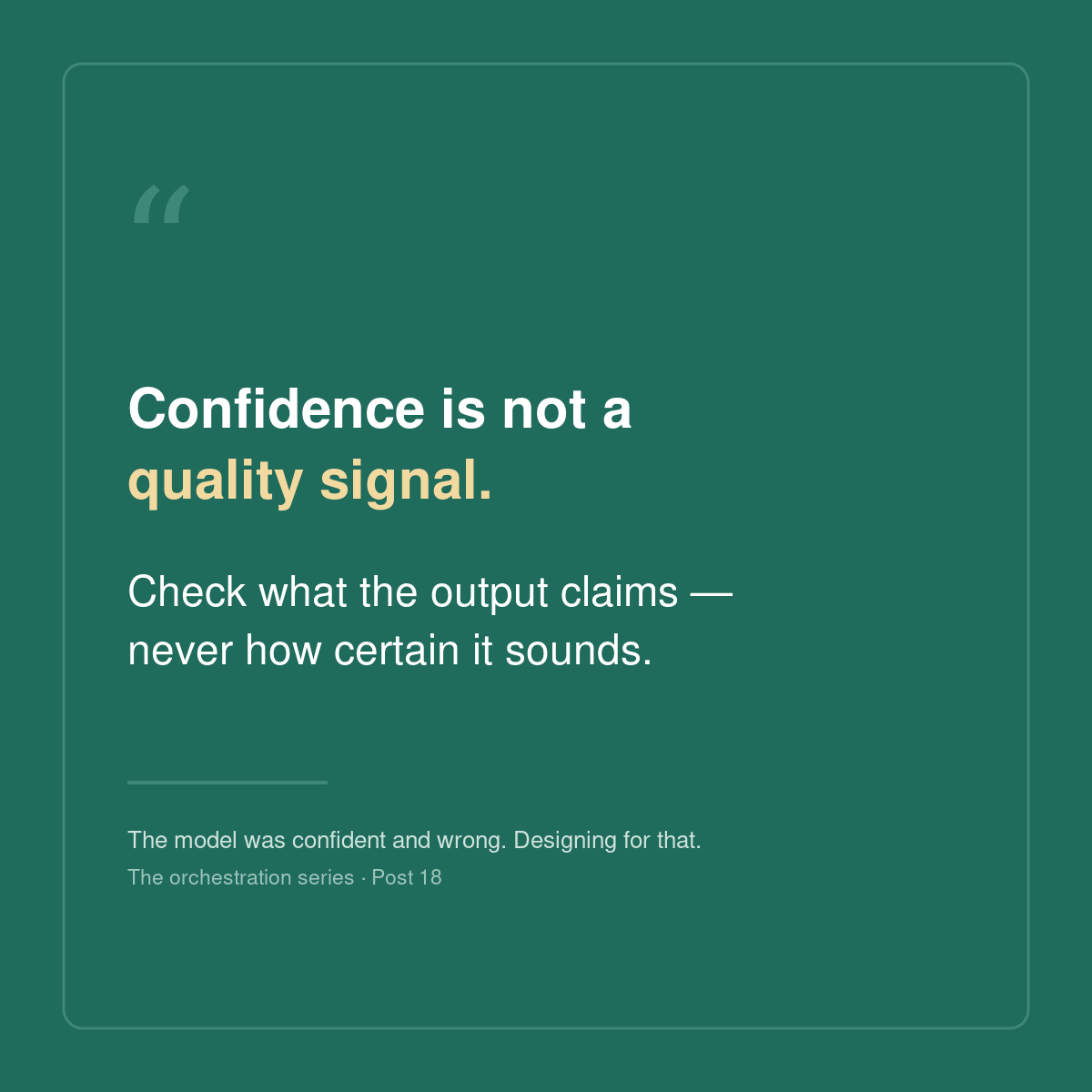
The model was confident and wrong. Designing for that.
Last week I argued that a quality gate earns its keep by where it sits — place the check just upstream of where the mistake turns expensive, and you catch defects while they're still cheap to fix. I stand by every word. So here's the failure that walks straight through all of it.
Last week I argued that a quality gate earns its keep by where it sits — place the check just upstream of where the mistake turns expensive, and you catch defects while they're still cheap to fix. I stand by every word. So here's the failure that walks straight through all of it.
You placed the gate perfectly. It ran. It passed. The bug shipped anyway.
The gate wasn't in the wrong place. It was checking the wrong thing. It checked whether the output looked finished — coherent, assertive, internally consistent, done. And a confidently wrong answer passes that check with full marks, because looking finished is the one thing a wrong answer can do just as well as a right one.
The tell that isn't
Here's the uncomfortable mechanic. Most reviews — human and automated — lean on fluency as a proxy for correctness. We trust the answer that reads clean, states itself plainly, and doesn't hedge. A hesitant answer makes us look twice. A confident one gets waved through.
That instinct was calibrated for humans, where confidence and competence are at least loosely correlated. It is miscalibrated for a model, where they aren't correlated at all. A model is trained to be fluent. Fluency is cheap for it, and it is exactly as fluent when it's wrong as when it's right. Confidence is not a signal the model emits about correctness. It's a signal it emits about style. And we keep reading it as the first thing.
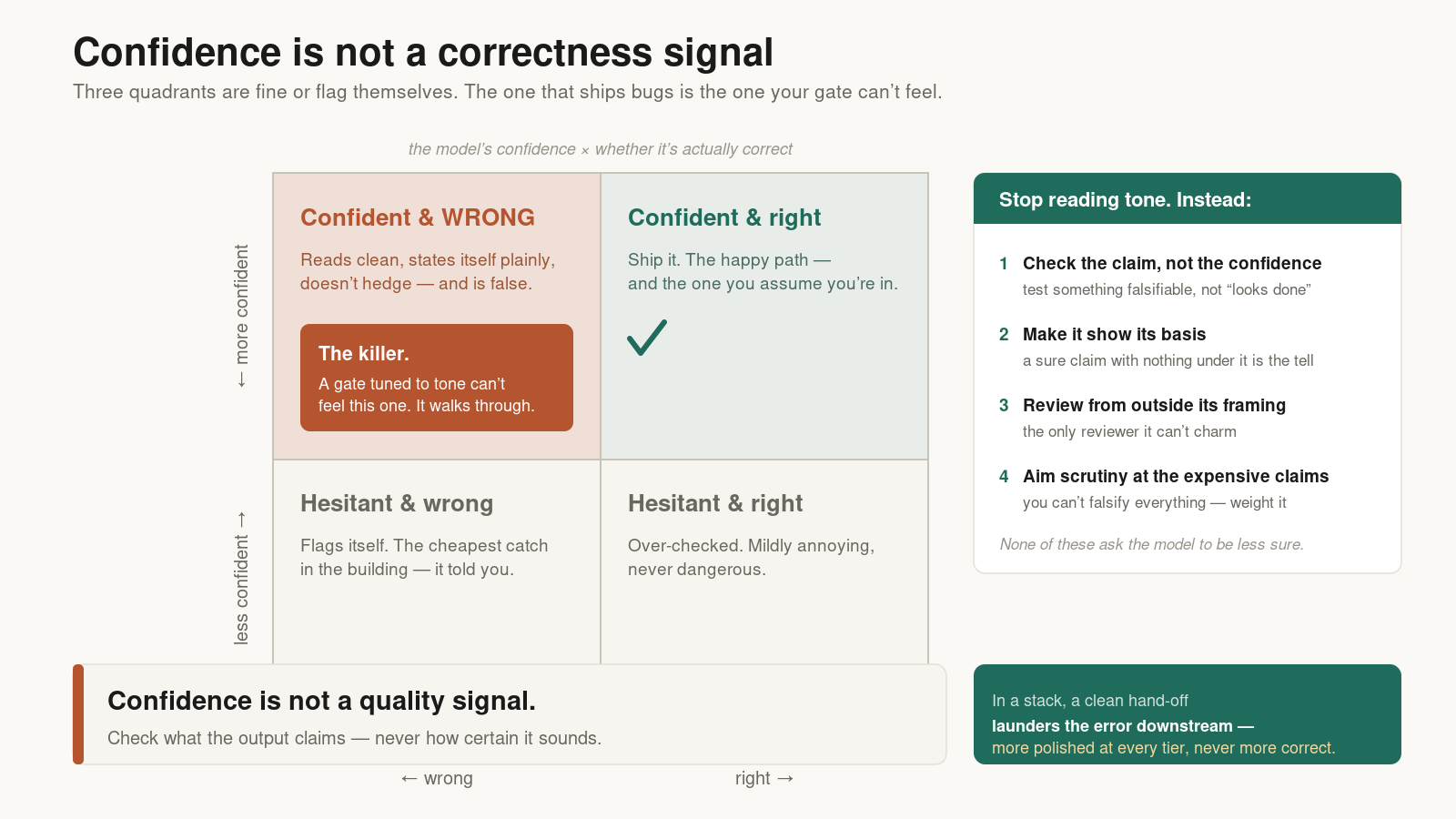
So the dangerous output is never the one that hedges. The one that flags itself is the cheapest catch in the building. The dangerous one is the answer that is sure, specific, well-structured — and false.
Why the stack makes it worse, not better
This is the part that should worry anyone selling orchestration, me included. A clean hand-off — the thing this whole series has been praising — launders a confident error downstream.
Watch it move. The architect states a wrong assumption with total authority. The orchestrator, doing its job well, decomposes that assumption faithfully into worker tasks. The workers, doing their jobs well, execute it flawlessly. Every tier performed. Every hand-off was clean. And the error rode all the way to the output getting more polished at every step — never more correct, just better dressed.
A three-tier stack isn't a confidence filter. Left to itself it's a confidence amplifier. Each layer adds production value to whatever it's handed, including the mistakes. And same-tier review — the rubber stamp I warned about three weeks ago — is worst of all here, because a confident wrong answer is most convincing to a reviewer that already shares its priors. It doesn't just pass. It gets agreed with.
Designing for confident-and-wrong
The useful half. You can't make a model hesitate at the right moments — that lever doesn't exist. So you stop relying on tone entirely and build the warning into the structure instead. Four moves:
- Check the claim, not the confidence. A gate should test a specific, falsifiable thing — does this number reconcile, does this path actually exist, does this handle the empty case — not whether the output reads as finished. "Looks done" is not a test. "This assertion is false" is.
- Make it show its basis. A confident claim with no checkable support is the real tell — not the confidence itself, but the absence of anything underneath it you can verify. Demand the working. An answer that can't point at what it's standing on is the one to distrust.
- Review from outside its framing. The only reviewer a confident wrong answer can't charm is one that doesn't share its assumptions — a different tier, stripped context, an adversarial brief. That's the independence argument from the reviewer-design post, and this is the failure mode it exists for.
- Spend your scrutiny where being wrong is expensive. You can't falsify everything, and trying is last week-before-last's overengineering tax. So weight the check toward the confident claims that cost the most if they're false. This is what a well-placed gate should actually inspect — not the whole output, but the load-bearing assertions.
Notice none of these ask the model to be less sure. They assume it will be sure, and sometimes sure and wrong, and they route around that fact.
The rule of thumb
The whole post in one line: confidence is not a quality signal — check what the output claims, never how certain it sounds.
Before you trust an output because it reads clean, ask the only question that matters: what specifically would be true if this were correct, and have I checked that — or have I just checked that it sounds right? If the honest answer is the second one, you haven't reviewed the work. You've admired its posture.
The book-chapter version
This is a plank of the forthcoming chapter on "Quality at Machine Speed." Speed takes away the thing that used to be our warning light. A human who's unsure slows down, hedges, asks. A model doesn't — it produces a confident answer at full speed whether it's right or not, so the hesitation we used to read as "look closer" is simply gone. Quality at machine speed means getting your warning from structure instead of from tone: falsifiable checks, independent review, scrutiny aimed at the expensive claims. The faster the work, the less you can afford to trust how sure it sounds. (Still a forthcoming reference — it becomes a real citation the moment the date lands. It hasn't, yet.)
The short version
A perfectly-placed gate still passes a confidently wrong output, because most gates check whether the work looks finished and a wrong answer looks finished just fine. Confidence and correctness are different axes; the model is world-class at the one that fools your reviewer. Orchestration makes it worse — a clean hand-off launders a confident error downstream, polishing it at every tier. So stop reading tone: test falsifiable claims, demand a checkable basis, review from outside the output's own framing, and aim your scrutiny at the assertions that are expensive if they're wrong. Last week was where to put the gate. This week is what it has to actually look at. Next week goes deep on the other side of this coin — not the failures that slip through review, but when the whole heavy apparatus of independence is itself the wrong call, revisited with fresh examples.
If you're testing Fable 5 / Opus 5 too, where did it land for you? And the confident-wrong version: what's the most confidently wrong answer a model has handed you — and did your review catch it, or did its tone?
Diagram: confidence × correctness — the four quadrants, with the confident-and-wrong corner marked as the one a tone-tuned gate can't feel.
*Series: Post 1 — Fable 5 talks to machines better than to people · Show me the receipts · Show, don't tell · Why I took the architect tier out · The RPIQ loop · Where the stack was overkill · BowSmith case study · I lost my favourite tool · Opus Max as architect · Fable 5 came back · CAST26: open season as a quality gate · Opus 5: the middle ground I chose · Is the token even the right unit of account? · Routing rules: which tier gets which task · Stop prompting, start delegating · Reviewer design: catching what the architect tier misses · The overengineering tax: when three tiers cost more than one · Gate design 101: where quality checks belong in the loop ·