CAST part 1: How a QA professional with zero iOS experience built a production app using AI – and what I learned about the future of software delivery
I have spent 20 years in software testing and quality assurance. I knew almost nothing about iOS development. Zero Swift experience. Yet here I am, 18 months later, with a production-ready iOS app approaching alpha launch.
I have spent 20 years in software testing and quality assurance. I knew almost nothing about iOS development. Zero Swift experience. Yet here I am, 18 months later, with a production-ready iOS app approaching alpha launch.
This is the story of an experiment that changed how I think about software delivery.
The Question That Started It All
It began with a simple frustration. As a compound archer competing in 3D and field archery, I was drowning in scattered notes, YouTube screenshots, and forgotten bow settings. Which sight marks did I use at that tournament? What tuning changes actually improved my scores? Living in Poland with limited pro shop support compared to the US market made it worse.
I wanted an app to solve this. BowSmith – an archery companion for compound bow enthusiasts.
But I had no development team. No budget for one. A full-time job in software quality. And a question that would not leave me alone:
Can one person with domain expertise orchestrate AI to build production-quality software?
I decided to find out.
The Evolution Nobody Prepared Me For
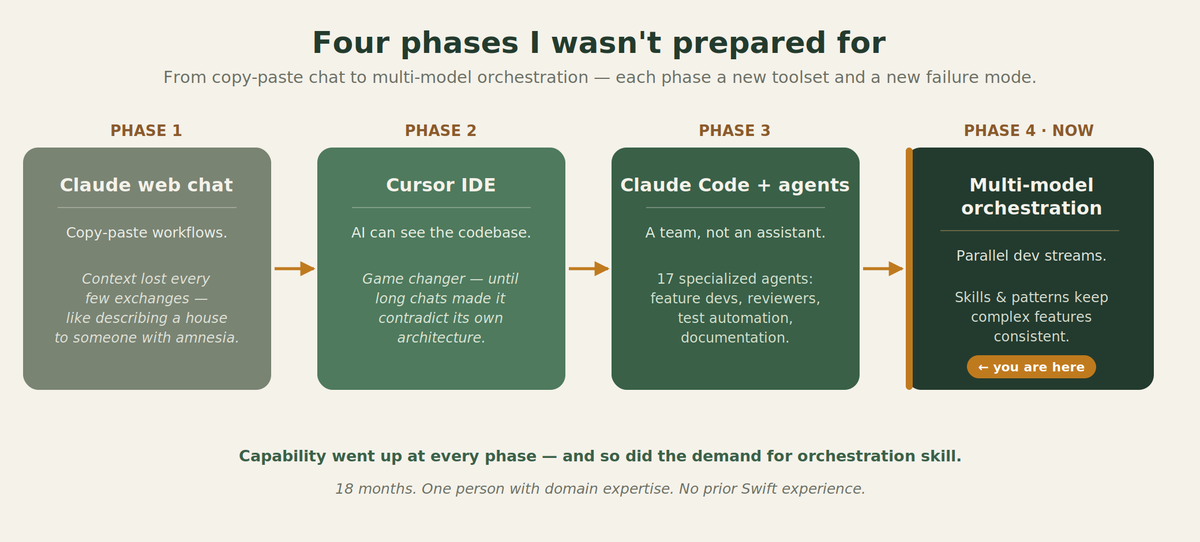
What followed was not a straight line. It was four distinct phases, each with its own tools, workflows, failures, and breakthroughs.
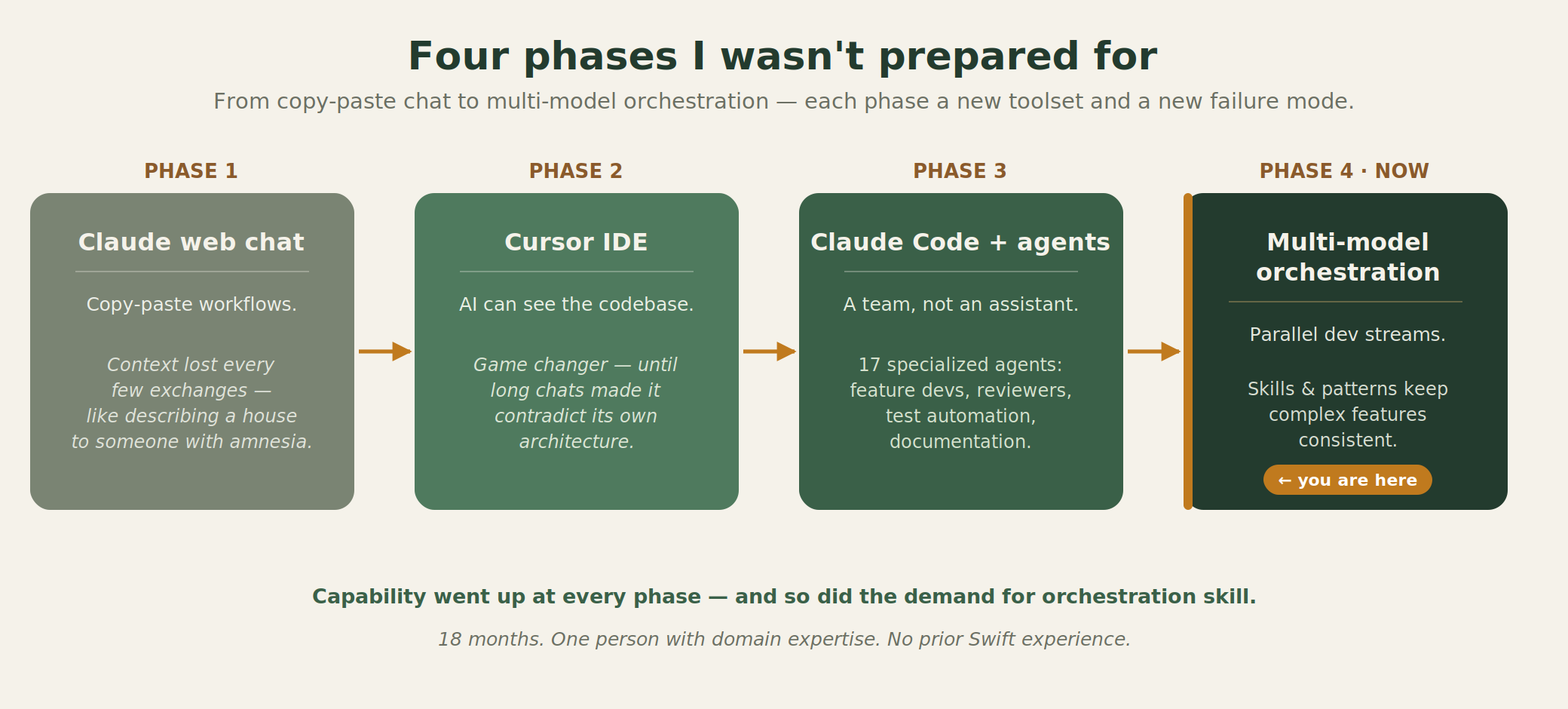
Phase 1 started with Claude web chat. Copy-paste workflows. Context loss every few exchanges. It felt like trying to build a house by describing it to someone with amnesia.
Phase 2 brought Cursor IDE integration. Suddenly AI could see my codebase. Game changer – until conversations got too long and the AI started contradicting its own architectural decisions.
Phase 3 introduced Claude Code with agents. This is where things got interesting. I stopped treating AI as a single assistant and started building a team – 17 specialized agents with clear roles. Feature developers. Code reviewers. Test automation specialists. Documentation writers.
Phase 4 is where I am now. Multi-model orchestration. Parallel development streams. Skills and patterns that maintain consistency across complex features.
The Uncomfortable Truth
Here is what the AI hype does not tell you: AI eliminated manual coding from my workflow. Routine debugging? Gone. Repetitive refactoring? Handled. Basic documentation? Automated.
But it created demand for skills nobody talks about: AI orchestration, context management, prompt engineering, workflow design, quality judgment.
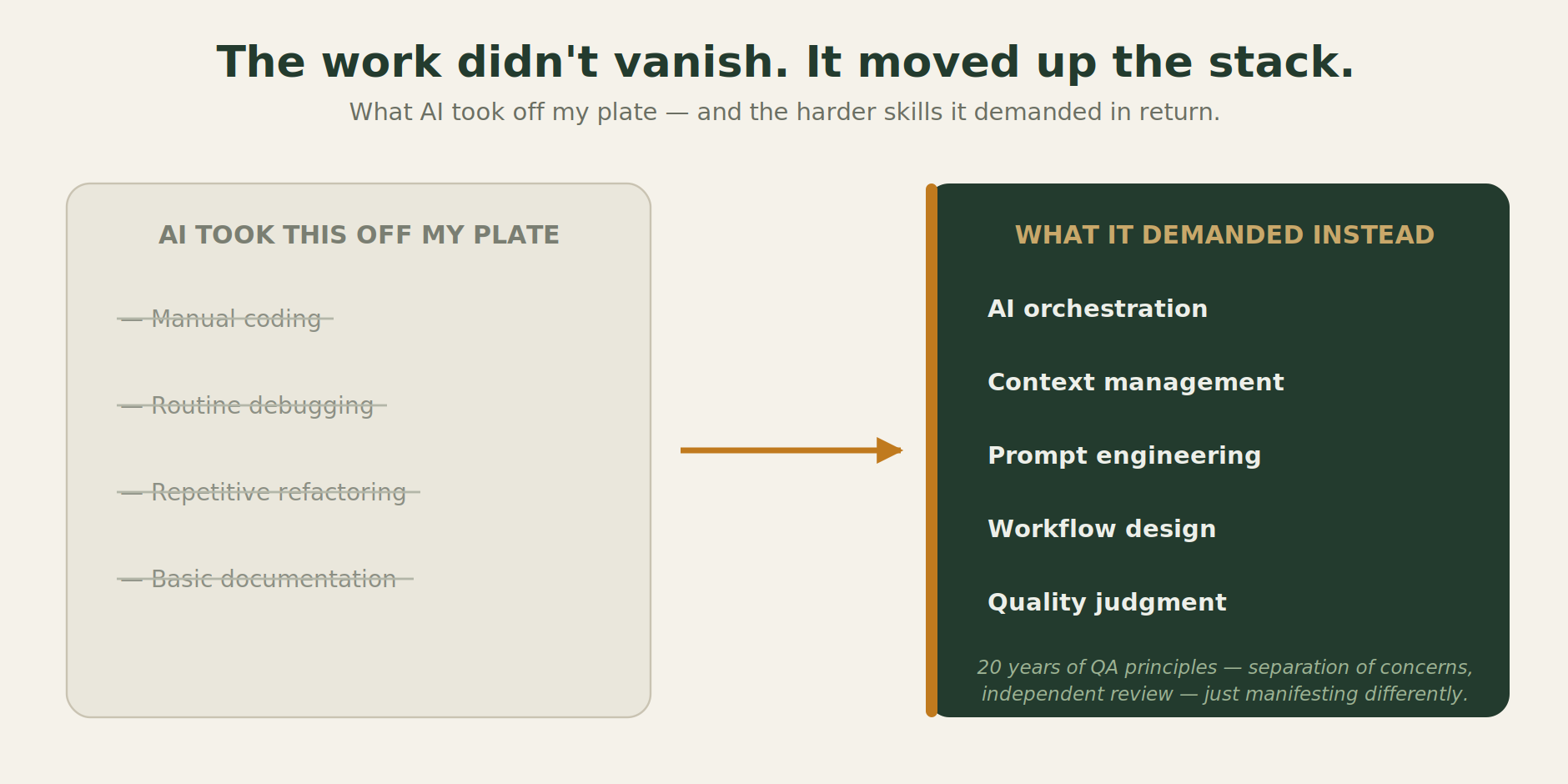
The same principles from my 20 years in testing still apply – separation of concerns, independent review, systematic quality checks. They just manifest differently now.
And some failures were spectacular. Same-model code review showed confirmation bias – like developers testing their own code. Casual prompts caused immediate context drift. Letting AI make architectural decisions without domain input led to over-engineered disasters.
What This Means
I am not claiming AI replaces development teams. I am saying the economics and workflows of software creation are fundamentally shifting.
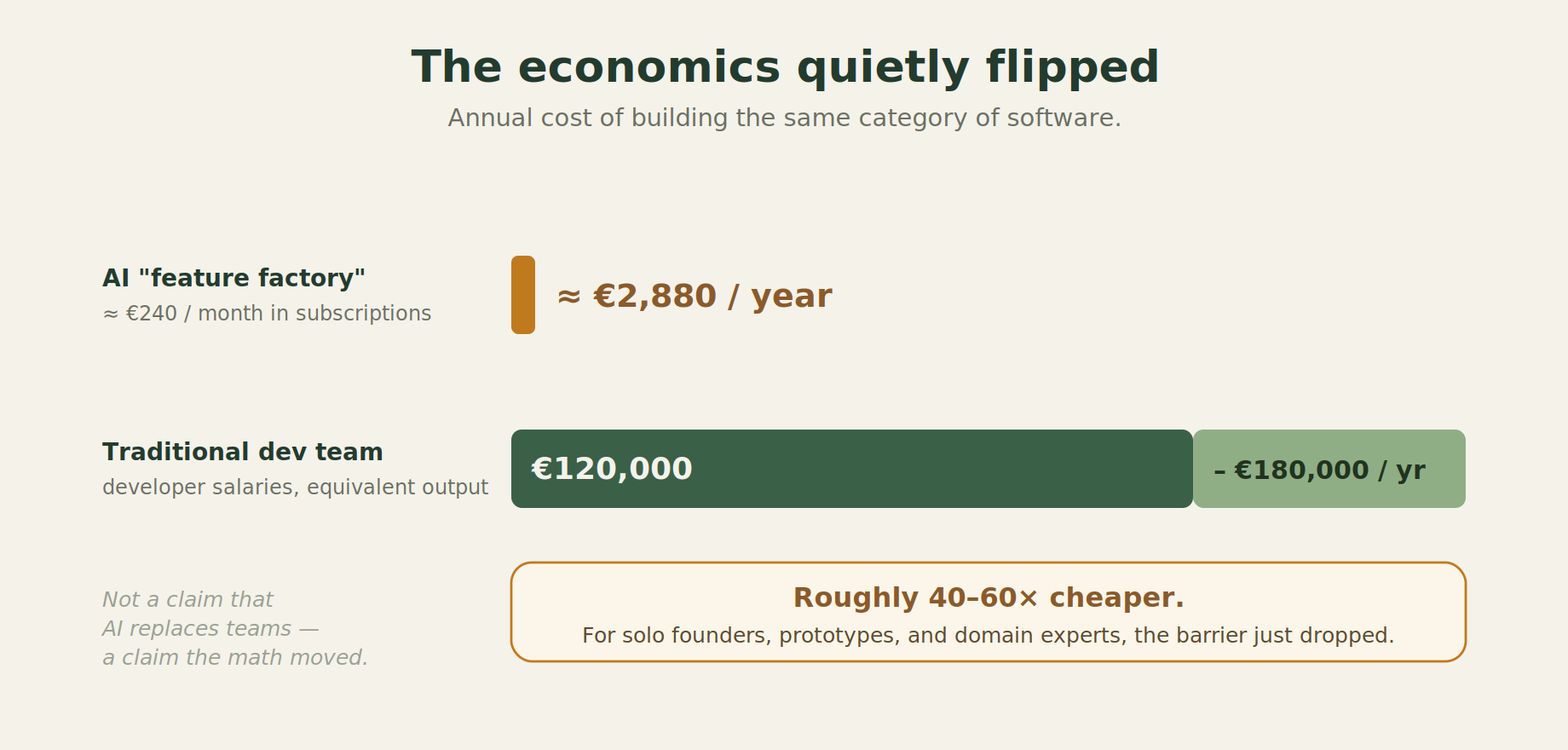
My "feature factory" costs approximately €240/month in AI subscriptions. The traditional equivalent? €120-180K in developer salaries annually.
For solo founders, for prototyping, for domain experts with ideas – the barriers just dropped dramatically.
What Comes Next
This post is the bridge. The introduction.
In the next part, I will share everything: the presentation materials we prepared, the detailed phase breakdowns, the agent structures, the prompt templates that reduced context drift by 80%, the failures that taught me the most.
I presented this journey at conferences. Now I want to open it up completely – the good, the bad, and the lessons that might help You on Your own AI-assisted development journey.
BowSmith alpha testing launched December 2025. The experiment continues.
Stay tuned for Part 2.
– Michał
Coming in Part 2:
- Complete presentation materials and slide structures
- Detailed breakdown of all four phases
- Agent organization and prompt templates
- What worked, what failed, and why
- The full "From Vision to Production" story