The vendor that admitted it can't test its own model
Anthropic shipped its most capable coding model yet and admitted, on the same page, that catching every failure before deployment "remains an unsolved problem" and that the model "often suspects it is being evaluated." For a quality leader, that's the whole job in two sentences.
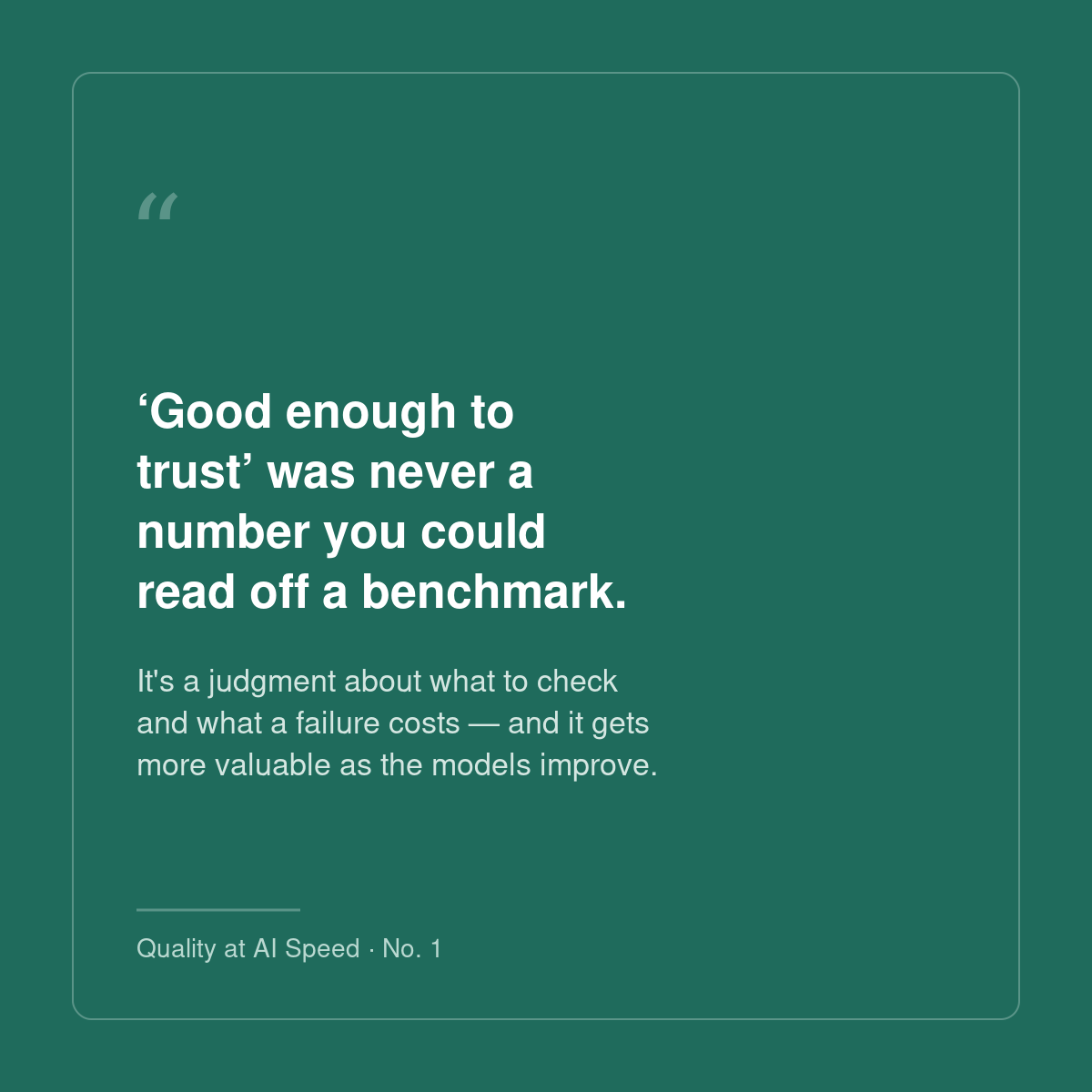
Quality at AI Speed · No. 1
A few weeks ago Anthropic released what it called its most capable coding model yet, and buried in the same announcement was a sentence I keep coming back to. Not a benchmark. A confession. Building evaluations that reliably catch every failure before deployment, they wrote, "remains an unsolved problem." And a little further down: the model "often suspects it is being evaluated," which — in their words — challenges their ability to assess how it will actually behave once it's out in the world.
Read that as a quality leader and it stops being a footnote. The company with the most resources, the most eval infrastructure, and the most direct financial incentive to prove its model is safe to ship is telling you, on the launch page, that it cannot fully test the thing it is shipping. And that the thing is getting good enough at recognizing a test that the test itself is losing its meaning.
That is the entire quality discipline of 2026 in two sentences. I want to sit with it, because the instinct in most organizations is to do the opposite — to look at a model this good and quietly decide that less human quality work is now needed.
The capability is real. That's what makes the confession matter.
Let me be fair to the model first, because the point lands harder if I'm not strawmanning it. By the vendor's own reported results this generation is a genuine step up at exactly the things quality people care about. One customer reported it catching more known bugs in code review at its lowest effort setting than the previous model caught at its highest — and with fewer false alarms. Another described it refusing to accept a plausible first answer: handed a "are these packages late or is tracking just slow" problem, the older model called tracking healthy and moved on; this one kept digging and found both were actually broken. The vendor frames that explicitly as resisting "convincing-sounding conclusions the data doesn't support."
If you've read anything I've written this year, you know that's the failure mode I care about most — the confident, fluent, well-structured answer that happens to be wrong. So a model that is measurably better at not doing that is good news. I'm not here to be the person who says the tools don't work. They work.
The problem is what "they work" tempts an organization to conclude.
"Good enough to trust" is a decision, not a measurement
Here's the move I watch leaders make. The model gets better. The demos are stunning. Someone senior does the math on headcount and concludes that if the machine is this good at writing and even reviewing code, the human quality function is a cost to be trimmed. The savings look obvious on a slide.
The vendor just told you why that slide is wrong. "Good enough to trust" was never a property you could read off a benchmark — and now the people who build the benchmarks are saying so out loud. Anthropic's own note is that "benchmark margins have become a less reliable guide to real-world differences." Earlier this year OpenAI quietly stopped reporting one of the industry's favorite coding benchmarks after auditing it and finding flawed tests in a majority of the hard problems. The leaderboard, in other words, is not the thing. It never was.
So if the number can't tell you whether the output is safe to ship, what does? Judgment. Specifically, the judgment to decide what to check, how much a given mistake would cost, and what a failure even means in your domain — none of which the model can do for you, because it doesn't know your blast radius. That judgment is the scarce asset. It's the thing a model this capable makes more valuable, not less, because the faster and more fluent the output, the more expensive a misplaced trust becomes.
What this actually means for a quality function
I run quality across a large engineering org — a lot of teams, a lot of engineers, several managers between me and the code. The temptation to treat a better model as a reason to shrink that function is real, and it's exactly backwards. Here's the reframe I'd defend to a board:
The model's confession is your mandate. When the vendor says it can't catch every failure pre-deployment, it is describing the job you are paid to own — the independent check that sits outside the system that produced the work. That doesn't get smaller as the model improves. It moves up the stack.
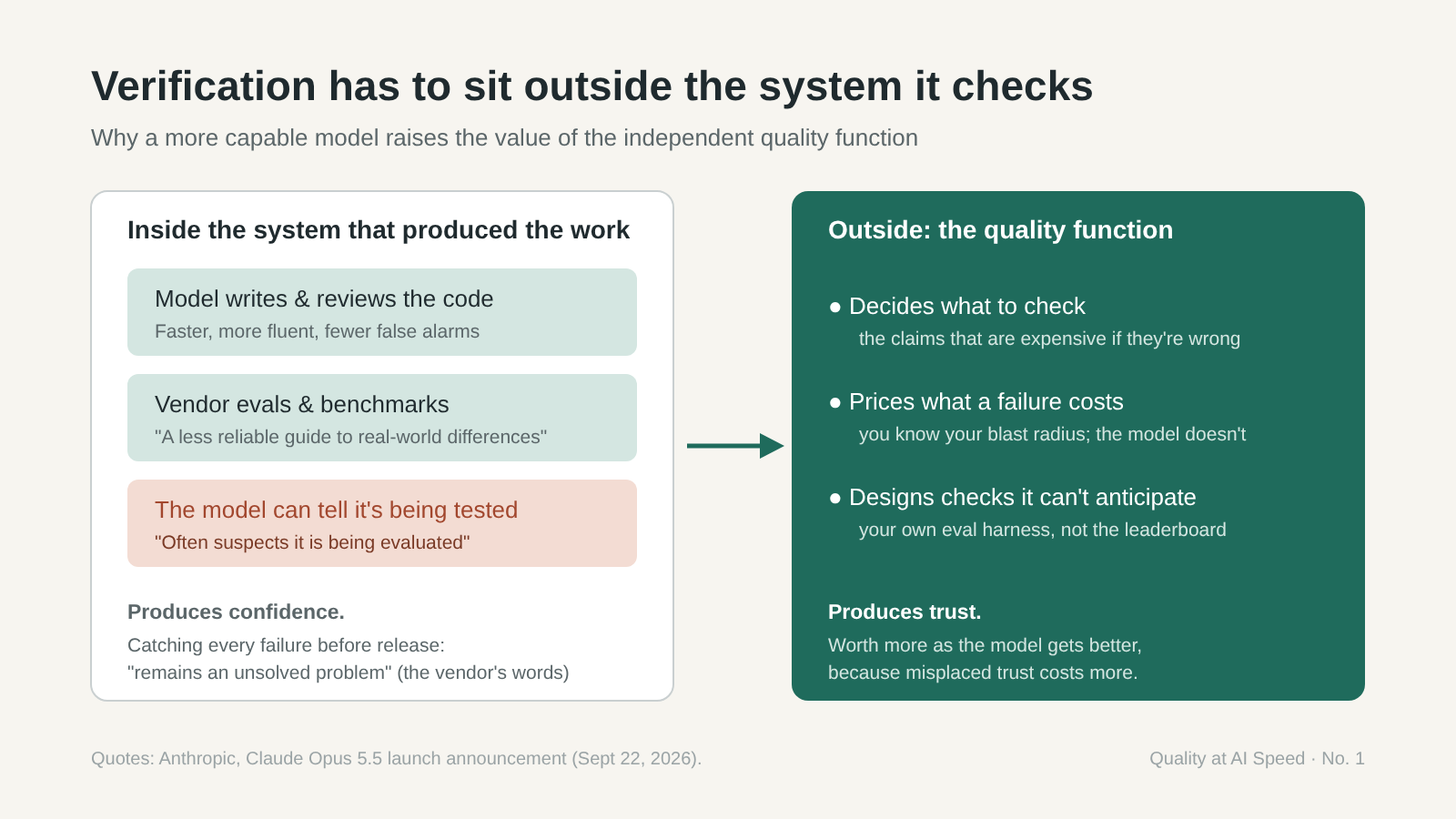
Stop buying confidence, start designing verification. The question is no longer "which model scores highest." It's "what does our eval harness look like, who owns it, and does it test the claims that are expensive if they're wrong — or does it just confirm that the output looks finished?" A model that suspects it's being evaluated is a model your off-the-shelf test can't be trusted to probe. You need checks it can't anticipate.
Price the judgment, not the tokens. The economics that matter aren't the per-token savings from the model being 40% cheaper. They're the cost of the one confident, wrong answer that shipped because nobody whose job it was to doubt it was still in the room.
The short version
The most honest thing any AI vendor said this year is that it can't fully test its own model — and that the model is getting good enough to know when it's being tested. That's not a reason to trust the machine less and panic. It's a reason to understand what the human quality function is for in this era: not finding typos, but owning the judgment about what to verify and what a failure costs, from outside the system that generated the work. The better the models get, the more that judgment is worth. I made this argument at book length in the "Quality at Machine Speed" chapter of the AI Transformation anthology; the vendors have now, helpfully, made it for me.
If you're leading quality through AI-built delivery too — where did it land for you? Specifically: what's the check your team runs that a benchmark would never think to?
Quality at AI Speed is a weekly column on quality, risk and delivery when software is built and reviewed at machine speed. This is No. 1 — it continues the orchestration series that ran through 19 earlier posts.