I Wrote a Chapter About Trust. A Machine Helped Me Test the Argument.
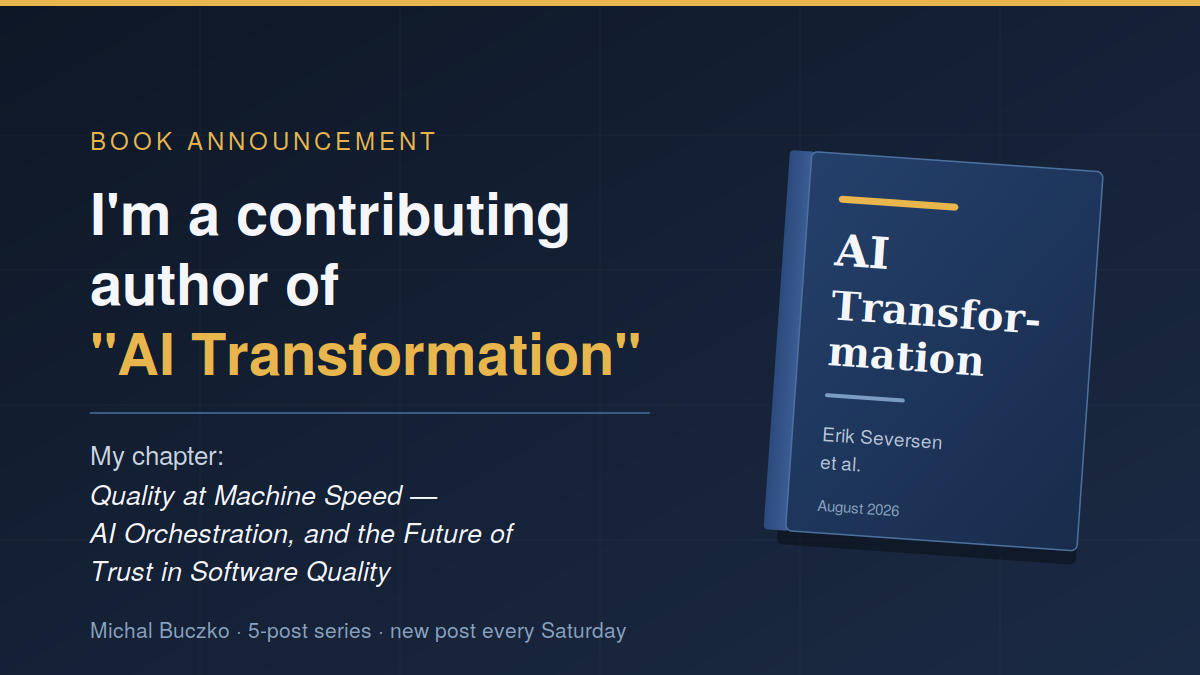
Post 1 of 5 — announcing "AI Transformation" and my chapter, "Quality at Machine Speed". Some news I've been sitting on for a while: this August, I'm becoming a published book author.
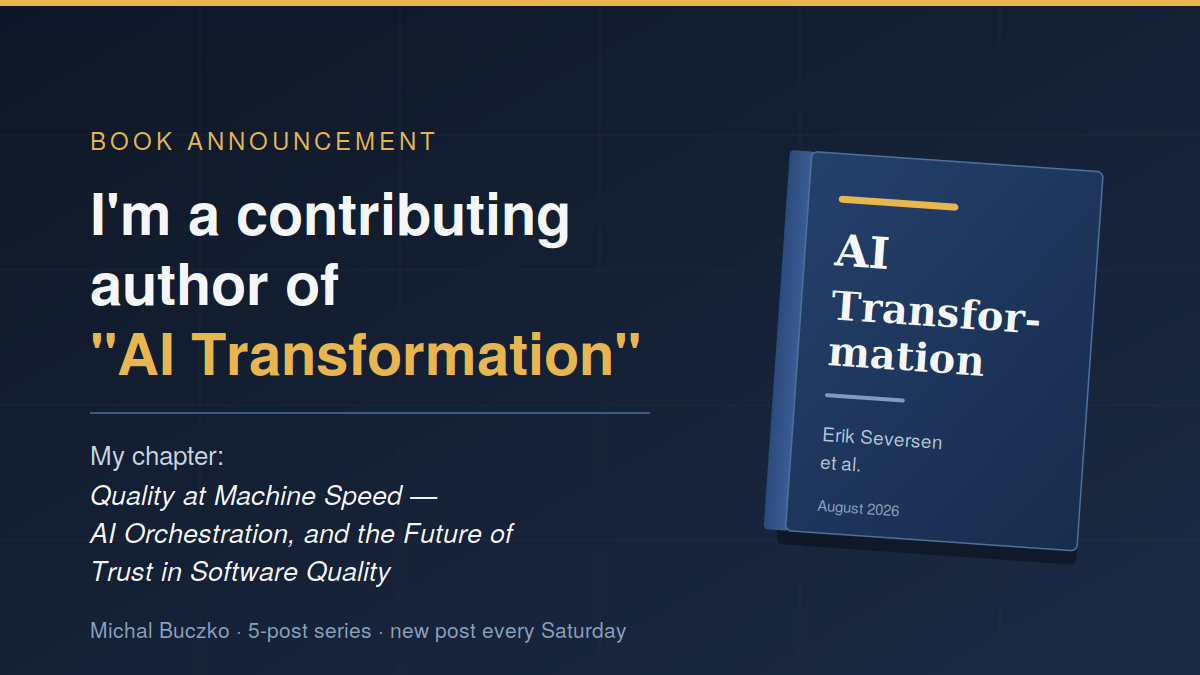
Post 1 of 5 — announcing "AI Transformation" and my chapter, "Quality at Machine Speed". Some news I've been sitting on for a while: this August, I'm becoming a published book author.
I've contributed a chapter to "AI Transformation", the newest title in Erik Seversen's multi-author book series on AI and how it's reshaping work, business, and daily life. My chapter is called "Quality at Machine Speed: AI Orchestration, and the Future of Trust in Software Quality" — and over the next five weeks, I'll be walking you through what's in it, why I wrote it, and what I learned along the way.
The book, and the series behind it
If you haven't come across Erik Seversen's books before, the format is worth knowing about. Erik brings together practitioners from different industries and countries — engineers, executives, researchers, founders — and each contributes one chapter on the same broad theme, grounded in their own field and their own evidence. Previous books in the AI series include The AI Revolution, The AI Shift, The AI Advantage, and The AI Opportunity, each pairing Erik with around ten co-authors.
That format is exactly why I said yes. A single-author AI book gives you one lens. A multi-author book gives you a dozen practitioners who all watched the same wave hit their own shore — and wrote down what actually happened, not what the hype cycle predicted.
"AI Transformation" is planned for release in August 2026 (final date to be confirmed — I'll share it here and on LinkedIn the moment it's locked in).
Why I wrote about trust, of all things
I've spent my career in software quality. For most of that time, the job had a comfortable, well-understood rhythm: humans wrote code at human speed, and quality processes — reviews, test cycles, release gates — were built around that speed. That rhythm is gone.
AI-assisted development means code, tests, and documentation are now produced faster than any human team can read them, let alone review them. And here's the uncomfortable part almost nobody in the tooling market wants to say out loud: the bottleneck was never writing the software. It was trusting it.
Speed without trust isn't acceleration — it's just faster accumulation of risk. That tension is what my chapter is about. Not "will AI take QA jobs", not "10x your velocity with these prompts", but a practitioner's answer to a harder question: when machines produce most of the artifacts, how does anything earn the right to ship?
My answer, in one word, is orchestration — treating AI output the way we've always treated unproven work: as a prototype that has to earn trust by passing through deliberate, observable quality gates. The chapter lays out how to build that: the pillars an orchestration approach stands on, a working loop for turning AI output into verified work, and the specific failure modes that show up when you skip the gates.
What's coming in this series
Over the next four Saturdays I'll go deeper into the chapter, one theme at a time:
- Post 2 — The Speed Trap. What actually breaks when the software lifecycle accelerates past human review speed, and why the trust gap is a structural problem, not a discipline problem.
- Post 3 — RPIQ and Quality Gates. The working loop from the chapter: how AI-generated code goes from plausible prototype to trusted, shippable artifact.
- Post 4 — A look at the wider book. The co-authors and their chapters — or, if the final manuscript isn't in my hands yet, a dive into the four failure modes of unverified AI output.
- Post 5 — Launch. The book is out: where to get it, and what five weeks of writing about trust taught me.
One personal note
Writing a book chapter is a strange exercise for a quality engineer. You spend years making claims that are checked by pipelines, tests, and production incidents — and then suddenly you're making claims that are checked only by readers. It forces a certain honesty: everything in the chapter is something I've seen work, or seen fail, in real projects. Evidence over hype. That's the standard I've tried to hold, and it's the standard I'll hold in this series too.
If the question of trusting machine-made software is on your mind — and if you ship software in 2026, it should be — follow along. The next post lands Saturday, August 29.
Michal "Mike" Buczko is a contributing author of "AI Transformation" (Erik Seversen et al., planned for August 2026). His chapter, "Quality at Machine Speed: AI Orchestration, and the Future of Trust in Software Quality," examines how software teams can keep trust intact when AI accelerates delivery beyond human review speed.