In continuous delivery, the pipeline is not where testing ends
Most teams treat a green pipeline as the end of testing. In continuous delivery it is the middle. The real practice is designing how cheaply you can be wrong once the change is live.
Most teams treat a green pipeline as the moment testing is done. In continuous delivery, that is the moment testing changes shape.
A pipeline answers one question: did this change behave as expected in the conditions we could think of? Production answers a different one: did it behave in the conditions that actually exist? Continuous delivery means that second question gets asked many times a day. Any testing practice that stops at the deploy step has decided not to listen to the answer.
So the best practice in DevOps testing is not a longer pre-deploy suite. It is a deliberate split of responsibility between what you check before release and what you design to detect, contain and undo after.
Stop asking "is it tested?" and start asking "how expensive is it to be wrong?"
The classic question for a release is "is it tested enough?" In a world of quarterly releases that was a reasonable question. Every escaped defect lived in production for months, so you tried to catch everything up front.
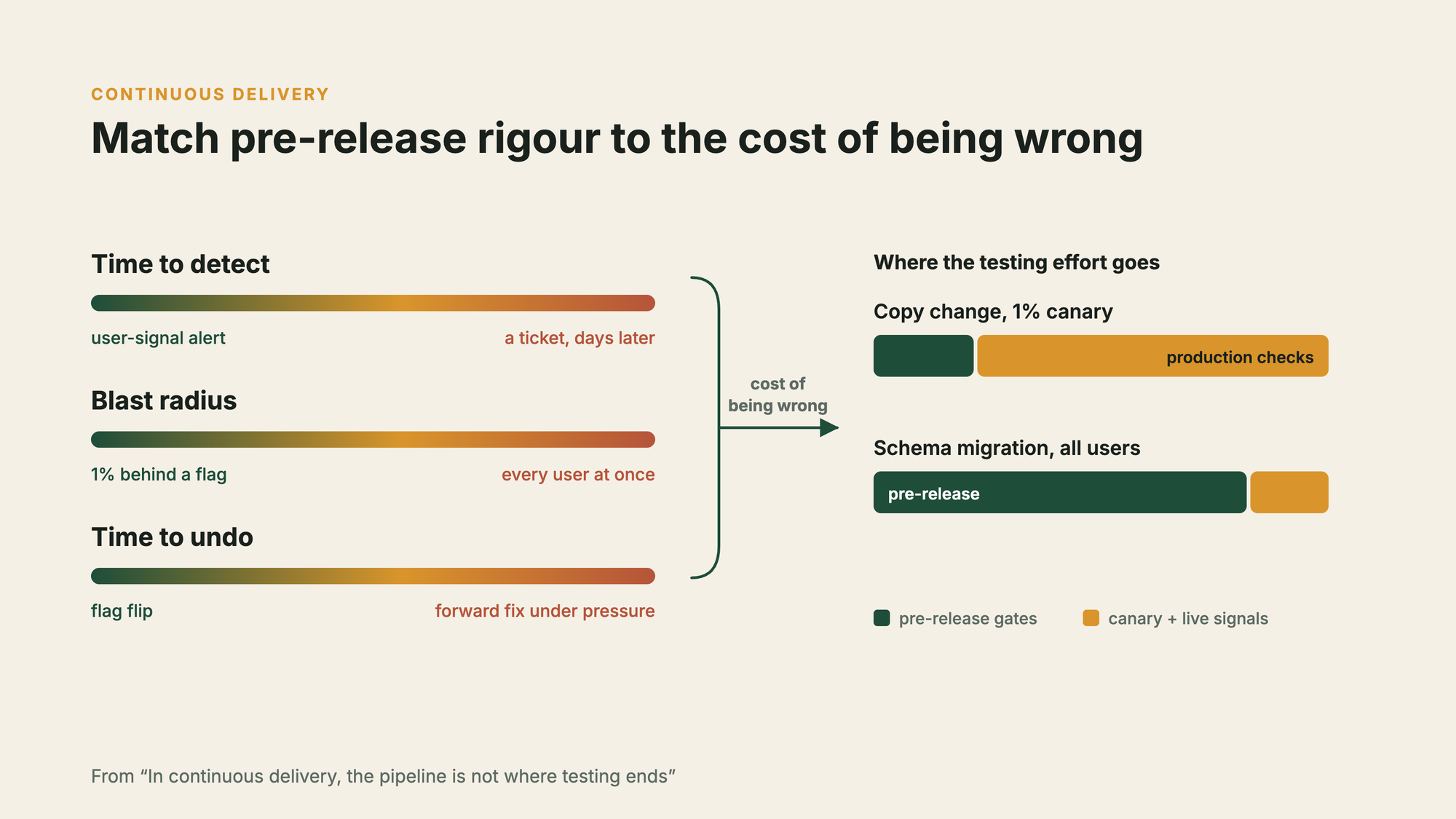
In continuous delivery, the more useful question is about cost. If this change is wrong, how quickly will we know, how many users will it touch, and how fast can we take it back? I call that the cost of being wrong, and it has three parts:
- Time to detect. Minutes, because an alert fires on a user-facing signal? Or days, because someone files a ticket?
- Blast radius. Every user at once, or one percent behind a flag?
- Time to undo. A flag flip, a one-click rollback, or a forward fix through the whole pipeline under pressure?
A change with low detection time, a small blast radius and a fast undo can ship with lighter pre-release checks. A change that is slow to detect, affects everyone, and cannot be rolled back, such as a schema migration, a payment flow or firmware on a device in a customer's home, needs much heavier ones.
That is the real DevOps testing strategy. It is not one suite for everything. It is matching pre-release rigour to the cost of being wrong.
Keep the pre-release pipeline fast, specific and trusted
None of this makes the pipeline less important. It makes speed and signal quality more important, because the pipeline is now one of several safety layers rather than the only one.
I have written about what belongs at each stage, from commit through merge, and what separates a gate that blocks from one that only decorates, in A Gate That Works, and a Gate That Only Looks Like One. I won't repeat it. Three practices matter most specifically for continuous delivery:
Guard the feedback time. A pipeline that takes forty minutes changes behaviour. People batch changes to avoid waiting, and batching is exactly what continuous delivery is supposed to remove. Set a time budget for the merge-blocking path and treat breaching it as a defect.
Quarantine flakiness ruthlessly. In a pipeline that runs dozens of times a day, a test that fails at random one time in fifty becomes a daily event. It teaches the team that red means nothing. Move flaky tests out of the blocking path immediately, give each one an owner and a deadline, and track the quarantine list like a bug backlog.
Test the deploy itself. Migrations, configuration, infrastructure changes and the rollback path are code. If your pipeline tests the application but not the act of deploying and undeploying it, you have tested the part least likely to hurt you.
Design production to tell you when you are wrong
This is the half of DevOps testing that teams most often leave to operations, and it is where quality engineers have the most to add.
Progressive exposure. Feature flags, canary releases and staged rollouts are test techniques. A canary is an experiment with a control group, run in the only environment that matters. The quality question is not whether to use them but what the pass condition is. A canary with no defined success criteria is not a test. It is a slow deploy.
Signals tied to behaviour, not just health. CPU and error rates tell you the service is alive. They do not tell you it is right. The checks that catch real defects in production watch user-level outcomes: orders completed, sync jobs succeeding, the ratio of a feature's starts to its finishes. A quality engineer who knows which behaviours matter is the right person to define those signals.
Synthetic checks of critical journeys. A small number of scripted end-to-end journeys running against production around the clock. They are cheap, boring and the fastest way to learn that something everybody assumed works has stopped.
I have seen this more than once. On global products we released region by region (Europe, Asia, the Americas, Australia), each at a different time, to limit customer impact. Pre-production looked fine: it ran on hardware simulators and the automated installation sanity suite was green. But after deployment, our QAs' manual smoke and regression testing found problems caused by server-side hardware changes we hadn't known about. The same happened with backend breaking changes that nobody caught in advance and that only showed up in production. Because we used blue-green deployment, we switched that region back to the old servers and kept its users on the previous release while we fixed, tested and prepared the new version in parallel.
Watch for the change that passes everything
The defects that hurt most in continuous delivery are rarely the ones that fail a test. They are the behaviour changes nobody wrote a test for, because nobody knew that behaviour was a commitment.
In Trust Is Produced, Not Felt I called these silent regressions: the suite encodes the lines executed, not the promises the system makes. Continuous delivery multiplies them, simply because there are more changes. AI-assisted development multiplies them again, because generated code is optimised to look correct and generated tests tend to adapt to the code rather than the requirements.
The counter-measure is differential evidence. For changes to anything users rely on, capture what the system did before and after: API responses, rendered output, emitted events. Make the difference something a reviewer sees. "All tests pass" says nothing about what changed. A diff of behaviour does.
Treat every escaped defect as a pipeline bug
The last practice closes the loop. When a defect reaches production, the instinct is to fix the code and move on. In a continuous delivery setup, the more valuable question is which layer should have caught it, and why it did not.
- Should a pre-release check have caught it? Then add the check, at the cheapest stage that can.
- Should production signals have caught it faster? Then add or sharpen the signal.
- Was the blast radius larger than it needed to be? Then the change should have gone behind a flag.
Over time this turns the pipeline and the production safety net into one system that learns. Without it you have a set of checks that reflects what went wrong two years ago.
A quick self-assessment
- Do you match pre-release rigour to the cost of being wrong, or run the same suite for every change?
- Is your merge-blocking path under a time budget someone owns?
- Does every canary or staged rollout have an explicit pass condition?
- Do your production signals measure user outcomes, or only service health?
- When a defect escapes, do you fix the pipeline as well as the code?
One more thing, from my own experience: a fast response, an efficient rollback and a quick fix-and-redeploy are often a better investment than trying to automate everything up front. There will always be surprises in production, and you cannot prevent them all. Staged rollouts, fast rollback and a working xOTA update path are a one-off investment that protects every future deployment. Heavy automation in pre-production environments needs continuous maintenance. And the cost of being wrong is high: your credibility as a software expert and your customers' trust are easy to lose and hard to earn back. Do as much as you can to protect that relationship with your users.
If your team is working through this, book a Virtual Quality Coffee and we can look at your pipeline together. Or tell me in the comments: which of the five did you answer "no" to?